



Remote ID Broadcast Modules
Not every drone comes from the factory with Standard Remote ID built in. For an aircraft that was not manufactured that way, an add-on Remote ID broadcast module is the second compliance path. This lesson covers what a broadcast module is, what it must broadcast, the visual-line-of-sight limit that comes with using one, and the single fact that is the most commonly confused point on the entire Part 107 knowledge test regarding Remote ID: a broadcast module reports a fixed takeoff location, not the aircraft's real, current position.
An add-on device for aircraft not built with Remote ID
A Remote ID broadcast module is a separate piece of equipment, attached to or carried by an unmanned aircraft, that broadcasts the required Remote ID message elements on the aircraft's behalf. It exists specifically for aircraft that were manufactured before Standard Remote ID was required, or that were simply never built with Standard Remote ID capability — a large population of drones already in pilots' hands when Part 89 took effect. Rather than replacing the aircraft, a remote pilot can add a broadcast module to keep flying it legally.
14 CFR § 89.115, titled "Alternative remote identification," is the operating rule for this method: a person may satisfy the Remote ID requirement of § 89.105 by equipping the unmanned aircraft with a Remote ID broadcast module and operating under the specific conditions that section sets, in place of using an aircraft built for Standard Remote ID under § 89.110.
The visual-line-of-sight condition that comes with using a module
Using a broadcast module is not a drop-in replacement for Standard Remote ID with no other conditions attached. Section 89.115(a)(2)(ii) requires that the person manipulating the flight controls be able to see the unmanned aircraft at all times throughout the operation. In practice, this means an aircraft complying through the broadcast module method must be flown within visual line of sight (VLOS) for the entire flight — it cannot be used to support a beyond visual line of sight (BVLOS) operation, even one that might otherwise be authorized by waiver or other means. Standard Remote ID aircraft do not carry this same built-in VLOS restriction from Part 89 itself, which is one more reason Standard Remote ID is generally the more flexible long-term compliance path for an operator planning to expand into BVLOS work.
Required message elements under 14 CFR 89.315
Section 89.315 sets the minimum message elements a broadcast module must broadcast, and comparing this list closely against § 89.305 from Lesson B is exactly how this distinction gets tested.
- A unique identifier for the module: the broadcast module's own serial number.
- Unmanned aircraft latitude, longitude, and altitude: the aircraft's current position in flight.
- Velocity of the unmanned aircraft: its current speed and direction.
- Takeoff location latitude, longitude, and altitude: the fixed point where the flight began — not the control station's current location.
- A time mark: a UTC time reference for the broadcast reading.
Notice what is missing compared to Standard Remote ID's list: there is no control station location element and no emergency status element in a broadcast module's required message set.
The one fact worth memorizing above all others
To be precise: a broadcast module still reports the aircraft's own live position (required by 89.315, same as Standard Remote ID's 89.305). What a broadcast module does not report is the control station's current location the way Standard Remote ID does — instead, it substitutes a single, fixed takeoff point for that piece of information, and that takeoff point never updates once the aircraft leaves the ground, even as the remote pilot may move around during the flight. This is the specific comparison the knowledge test is most likely to probe: do not assume "broadcast module" means the aircraft's position itself goes unreported, and do not assume the fixed point it does report is the aircraft's current position rather than where the pilot and aircraft started.

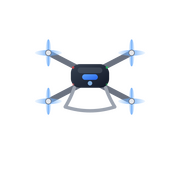
A Remote ID broadcast module attached to an aircraft not built with Standard Remote ID, with the VLOS requirement that comes with using it.
View LargerScenario: comparing a Standard Remote ID aircraft to a broadcast-module aircraft on the same flight profile
Two remote pilots each fly a similar mapping mission: launch from a parking lot, fly a grid pattern out to 2,000 feet away, and return. Pilot A's aircraft has Standard Remote ID built in; Pilot B's older aircraft uses an add-on broadcast module. A receiver on the ground watching Pilot A's flight sees the aircraft's position update continuously as it moves through the grid pattern, 2,000 feet out and back, along with Pilot A's current control station location at the parking lot. A receiver watching Pilot B's flight also sees the aircraft's own current position update as it moves through the same grid — but instead of a live control station location, it sees a single fixed point marking the parking lot where Pilot B's aircraft took off, which does not move even though the aircraft itself is now 2,000 feet away. Both broadcasts satisfy Remote ID, but they are not identical, and a knowledge-test question describing "a fixed broadcast location that does not change during the flight" is very likely describing a broadcast module's takeoff-location element, not a malfunctioning Standard Remote ID system.

The key comparison for the knowledge test: Standard Remote ID's live control station location versus a broadcast module's fixed takeoff location.
View Larger| Feature | Standard Remote ID (89.110/89.305) | Broadcast module (89.115/89.315) |
|---|---|---|
| Aircraft's own current location | Broadcast, updates in real time | Broadcast, updates in real time |
| Control station / pilot location | Broadcast, updates in real time | Not broadcast |
| Takeoff location | Not a required element | Broadcast, fixed for the entire flight |
| Emergency status | Required, when applicable | Not a required element |
| VLOS requirement from Part 89 itself | Not imposed by Part 89 | Required at all times, per 89.115(a)(2)(ii) |
| Typical use case | Factory-built compliant aircraft; supports future BVLOS growth | Retrofitting an existing aircraft built before Standard Remote ID |
| Mistake | Why it happens | Correct understanding | Regulation / source |
|---|---|---|---|
| Believing a broadcast module reports the aircraft's real-time position exactly like Standard Remote ID | Both methods do broadcast the aircraft's current position as a required element | Both do broadcast live aircraft position; the difference is the OTHER location element — a broadcast module reports a fixed takeoff point instead of a live control station location | 14 CFR 89.305, 89.315 |
| Assuming a broadcast module can be used for a BVLOS operation | The module still equips the aircraft with Remote ID, so it seems compliant either way | Section 89.115(a)(2)(ii) requires the pilot to see the aircraft at all times when using a broadcast module; it cannot support a BVLOS operation | 14 CFR 89.115(a)(2)(ii) |
| Thinking a broadcast module broadcasts emergency status like Standard Remote ID does | Emergency status is a required element for Standard Remote ID aircraft | Emergency status is not part of the minimum message element set required for a broadcast module under 89.315 | 14 CFR 89.315 |
| Assuming any add-on GPS tracker satisfies the broadcast module requirement | Both involve GPS location data | The module's serial number must be listed on an FAA-accepted declaration of compliance; an arbitrary tracker does not automatically satisfy 89.115 | 14 CFR 89.115 |
Does a broadcast module report the aircraft's live position or just where it took off?
Both, but they are two different elements. The aircraft's own current position updates in real time under 89.315, exactly like Standard Remote ID. What is fixed is the separate takeoff-location element, which stays at the original launch point for the entire flight and does not represent a live control station or pilot location.
Can I fly BVLOS using only a Remote ID broadcast module?
No. Section 89.115(a)(2)(ii) requires the person manipulating the flight controls to be able to see the aircraft at all times, which restricts broadcast-module operations to VLOS.
If my aircraft has Standard Remote ID built in, can I also just use a broadcast module instead?
Nothing in this lesson prevents it as a technical matter, but there is generally no reason to, since Standard Remote ID already satisfies § 89.105 without the VLOS-only limitation that comes with the broadcast module method.
Test Your Knowledge
Answer the questions below to check your understanding. Every answer can be found in the lesson above.