

Weight and Balance Basics for Small Drones
Every aircraft, from an airliner to a two-pound quadcopter, behaves according to where its weight is concentrated and how much total weight it's carrying. This lesson explains center of gravity and weight and balance in plain terms, shows how these concepts apply differently to multirotor and fixed-wing small unmanned aircraft, and explains why 14 CFR 107.15 makes checking this the remote pilot's own responsibility — there is no FAA-issued weight and balance manual handed to you the way a certificated airplane's is.
What "center of gravity" actually means
Every object, including an aircraft, has a single point at which its entire weight can be considered to act as if concentrated there — that point is the center of gravity (CG). If you could balance the whole aircraft on a single fingertip without it tipping in any direction, that fingertip would be sitting directly under the CG. Gravity always pulls straight down through this exact point, no matter how the aircraft is oriented, which is why CG location, not just total weight, determines how an aircraft handles.
Weight and balance is the broader practice of accounting for how much an aircraft weighs and where that weight is distributed, so the CG stays within the range the aircraft was designed to handle safely. A correctly loaded aircraft has its CG at or near the design point specified by the manufacturer; an incorrectly loaded one has its CG shifted forward, aft, left, right, or some combination — and that shift changes how the aircraft flies, sometimes dangerously.
Center of gravity on a multirotor
On a typical multirotor (quadcopter, hexacopter, octocopter), the flight controller assumes the CG sits at or very near the geometric center of the aircraft, directly beneath the rotor plane. The flight controller constantly adjusts individual motor speeds to keep the aircraft level and stable, which gives multirotors a surprising amount of built-in tolerance for small CG shifts compared to a fixed-wing aircraft — but that tolerance is not unlimited. A payload mounted well off-center, such as a gimbal-mounted camera hung asymmetrically or a delivery package strapped to one side of the frame, forces the flight controller to work harder to compensate, using motor power that would otherwise go toward climb, speed, or wind resistance.
Center of gravity on a fixed-wing sUAS
Fixed-wing small unmanned aircraft are far less forgiving of CG shift than multirotors, in the same way a manned fixed-wing airplane is less forgiving than a helicopter. A fixed-wing aircraft's CG must fall within a specific, usually narrow, range relative to the wing's center of lift. A CG too far forward makes the aircraft nose-heavy, requiring more elevator authority and increasing stall speed; a CG too far aft reduces longitudinal stability and, in a severe case, can make the aircraft difficult or impossible to recover from a stall or unusual attitude. Manufacturers of fixed-wing sUAS typically mark or specify an allowable CG range, and battery placement (often the single heaviest component) is the primary tool a pilot has to adjust it.
Why there is no FAA weight and balance manual for your drone
A certificated manned airplane is issued with an FAA-approved weight and balance section in its flight manual, with hard limits the pilot is legally required to calculate against before every flight. Small unmanned aircraft under Part 107 are not certificated in that same sense, and no equivalent FAA document exists for a specific drone model. Instead, 14 CFR 107.15(a) places the responsibility directly on the remote pilot in command: the aircraft may not be operated unless the remote PIC has determined it is in a condition for safe operation, which includes verifying that the loading — total weight, CG, and any payload — is within whatever limits the manufacturer publishes and within what the pilot's own judgment and experience with that aircraft supports.

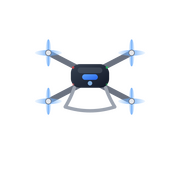
A correctly balanced multirotor keeps its center of gravity beneath the rotor plane's geometric center; an off-center payload shifts the CG and forces the flight controller to compensate continuously.
View LargerPayload placement in commercial operations
Weight and balance is not just an academic concept — it comes up on nearly every commercial sUAS mission that involves an add-on payload beyond the aircraft's stock camera. A thermal imaging sensor bolted to the underside of the frame, a multispectral sensor for agricultural mapping, a spray tank for crop application, or a delivery payload attached to a drop mechanism can each shift the CG significantly if not mounted according to the manufacturer's guidance. Reputable payload manufacturers publish mounting instructions specifically to keep the combined CG within the airframe's tolerance.
Worked scenario: an off-center thermal sensor
You are hired to fly a rooftop solar inspection using a quadcopter with an aftermarket thermal camera mounted on a bracket to one side of the airframe, rather than centered beneath the gimbal mount as the stock camera would be. Before launch, 107.15 requires you to confirm the aircraft is in a condition for safe operation — that includes checking whether the added weight and its off-center position are within the airframe manufacturer's payload guidance (if published), and, if not published, using a conservative test hover at low altitude in a controlled area to confirm the aircraft holds a stable, level hover without excessive corrective tilt before proceeding to the actual mission.
Fuel and battery weight changes during flight
Unlike a fixed load, battery weight does not change meaningfully during a flight (electric sUAS batteries do not lose significant mass as they discharge), so CG from the battery itself stays essentially constant throughout a mission. This is a meaningful difference from a fuel-burning manned aircraft, whose CG can shift measurably as fuel is consumed. However, a payload that is consumed or released in flight — a spray tank emptying, or a delivery package being dropped — does shift the CG mid-flight, and that shift must be anticipated during preflight planning, not discovered in the air.
When a load is simply too far out of tolerance
If a payload cannot be positioned to keep the CG within a safe range — for example, an oversized or irregularly shaped delivery item that cannot be mounted centrally — the correct response under 107.15 is not to launch and "fly around" the problem. The remote PIC's determination that the aircraft is in a condition for safe operation must be made honestly before the flight; if loading cannot bring the aircraft within a safe configuration, the operation should not proceed with that payload as configured.
| Airframe type | CG tolerance | Primary risk of CG shift | Typical correction method |
|---|---|---|---|
| Multirotor | Moderate — flight controller compensates continuously | Reduced control margin, increased power draw, visible tilt in hover | Center the payload beneath the rotor plane; use manufacturer mounting points |
| Fixed-wing sUAS | Narrow — specific range relative to wing center of lift | Nose-heavy: higher stall speed. Tail-heavy: reduced stability, harder stall recovery | Reposition battery or ballast per manufacturer's marked CG range |
| Any airframe, mid-flight payload release | Depends on release location relative to CG | Sudden CG shift at the moment of release (spray, delivery drop) | Plan release point/method so remaining CG stays within tolerance |
Checking Weight and Balance Before a Payload Flight
Run through this sequence any time you're flying with a payload other than the aircraft's stock configuration.
Check the manufacturer's published payload and CG guidance
Look for a maximum takeoff weight (MTOW), maximum payload weight, and any specified mounting location or CG range for that airframe.
Weigh the payload and confirm total weight is within MTOW
Add the payload weight to the aircraft's empty weight and confirm the total does not exceed the manufacturer's maximum takeoff weight.
Mount the payload as close to the design CG as possible
Use manufacturer-provided mounting points where available; center the payload left-right and front-back relative to the airframe when no specific point is provided.
Run a low-altitude test hover in a controlled area
Before proceeding to the mission, hover at a low, safe altitude and watch for excessive tilt, drift, or unusual motor sound — signs the flight controller is fighting a significant CG imbalance.
Document the configuration for repeat missions
If the same payload will be flown repeatedly, record the mounting position and any adjustments made so future preflight checks are faster and consistent.
| Mistake | Why it happens | Correct understanding | Regulation / source |
|---|---|---|---|
| Assuming multirotors are immune to weight and balance issues | The flight controller automatically compensates for small imbalances | Compensation has limits; a significantly off-center payload still degrades performance and control margin. | 14 CFR 107.15(a) |
| Looking for an FAA weight and balance manual for the aircraft | Manned aircraft pilots are used to a certificated flight manual with official W&B limits | No such FAA document exists for most sUAS; the manufacturer's own published data plus the remote PIC's own determination govern. | 14 CFR 107.15(a) |
| Treating maximum takeoff weight as the only variable that matters | MTOW is the single number manufacturers publish most prominently | A payload within MTOW can still be mounted off-center enough to create a real CG problem — weight and placement both matter. | Manufacturer flight manual / operating handbook |
| Assuming a stable ground hover guarantees a stable flight throughout the mission | The test hover looked fine at launch | A payload that is consumed, released, or shifts position in flight (e.g. spray tank, delivery drop) changes CG mid-mission and must be planned for separately. | 14 CFR 107.15(a) |
Do I need to calculate an exact CG position before every flight?
Not usually with a precise numeric calculation the way a manned-aircraft pilot might for a large fixed-wing airplane. For most sUAS, following the manufacturer's payload mounting guidance and confirming a stable test hover satisfies the 107.15 requirement to determine the aircraft is in a condition for safe operation. Precise CG math becomes more important on fixed-wing sUAS with a narrow published CG range.
Is weight and balance covered by a specific numbered Part 107 regulation?
There is no regulation specifically titled "weight and balance" in Part 107. The governing requirement is 14 CFR 107.15(a), the broader "condition for safe operation" rule, under which the remote PIC must determine the aircraft — including its loading — is safe before every flight.
Why are multirotors more tolerant of CG shift than fixed-wing sUAS?
A multirotor's flight controller continuously adjusts individual motor speeds to hold attitude and position, actively compensating for a shifted CG within limits. A fixed-wing aircraft relies on its aerodynamic design — the relationship between CG and the wing's center of lift — for inherent stability, which is much less adjustable in real time.
What happens if I fly with the CG outside a safe range anyway?
On a multirotor, expect reduced control margin, increased power draw, and possibly visible tilt or drift that eats into your safety margin, especially in wind. On a fixed-wing sUAS, an out-of-range CG can cause excessive stall speed, reduced stability, or make the aircraft difficult to control — a genuine safety hazard, not just a performance inconvenience.
Test Your Knowledge
Answer the questions below to check your understanding. Every answer can be found in the lesson above.